
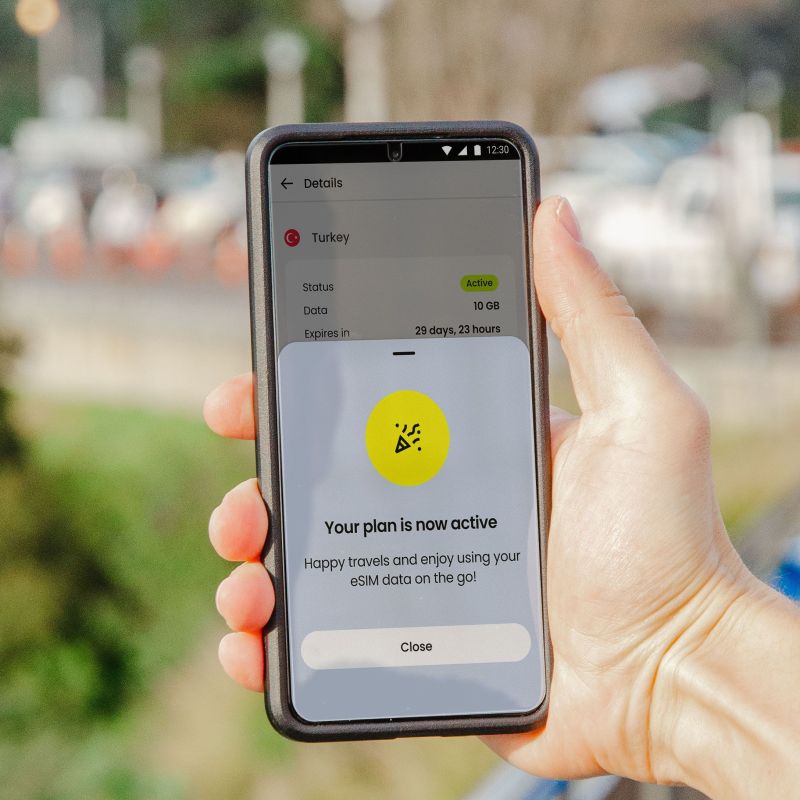
Over the last five years, eSIMs have turned from a hot topic to a must-have on many packing lists.
Videos by TravelAwaits
Traditionally, travelers have opted to either purchase a local physical SIM card for their smartphones or buy a limited international phone plan. Others might rely on Wi-Fi connections to get service instead of buying data. Travelers choose one based on their needs, including how often they need a connection and how far off the beaten path they’re wandering.
The rise of eSIMs has introduced a new option: Use a digital SIM card (aka an eSIM) to temporarily turn a smartphone into a local phone. Companies like Saily and Airalo let travelers purchase data plans that suit their needs, from cheap and limited plans to multi-month, comprehensive data packages.
But do you actually need an eSIM? Or is it better to go with an international phone plan from your usual provider? Here are the ins and outs of choosing between eSIMs vs international phone plans.
What’s the difference between eSIMs and international phone plans?
An international phone plan is an add-on or a data plan that you purchase from your existing service provider. An eSIM, on the other hand, is a temporary digital SIM card that sets you up with data at your destination. You can buy an eSIM from any trusted company that offers them, while the international phone plan is something your provider offers.
Electronic SIM cards come in a few different forms. In most cases, you download an app to gain access to the eSIM. You purchase your plan, then activate it via the app when you reach your destination. Other eSIM companies let you buy a plan online, then send you an activation code or QR code to start your data plan on a pre-set day.
International phone plans, on the other hand, usually charge a daily fee for usage or come in a monthly bundle. When you use an international phone plan, you’re gaining access to your provider’s partner network around the world.
Should you buy an eSIM for your next trip? Pros and cons
There are a few reasons that you might choose to purchase an eSIM to get service for your upcoming trip.
First and foremost, eSIM providers have taken off over the last five years. There are more trusted options than ever before, and they offer competitive pricing. In short, regardless of how remotely you plan to travel, you can find an eSIM that gives you reliable service, from India to Patagonia to Fiji.
Buying an eSIM plan also gives you more flexibility. As mentioned above, you can choose from unlimited data plans, daily data caps, and more. You can spend what you want while guaranteeing you have the right coverage. If you want to keep it basic, you can pay a few dollars for texting capabilities. If you want to go all-in, you can go for remote video streaming.
That brings up another important point: eSIM networks are local, giving you the most reliable service. You aren’t connecting to a partner’s network—you’re connected to a local 4G or 5G network that is reliable and fast enough to give you directions while you’re driving remotely, make calls from unlikely places, and more.
Lastly, eSIMs are easier to update and extend while you’re traveling. You can easily top up a limited plan or expand an unlimited plan if you decide to stay on the road longer. They’re better suited to travelers and digital nomads who aren’t sure where they’ll end up next and for how long.
Should you buy an international plan for your next trip? Pros and cons
With so many clear benefits of using eSIMs, who would bother with an international phone plan? In reality, major US providers like T-Mobile and Verizon now offer comprehensive, easy-to-arrange data plans, partly in reaction to the proliferation of eSIMs. In other words, by going online or by calling your provider, you can easily add on a plan to get coverage during your trip.
Most companies offer prepaid or postpaid plans, along with single-day or multi-day passes. Prices are comparable with eSIMs, but the main difference is that your standard service provider might not tell you that you’ve exceeded limits; instead, you’ll notice that you owe more than you thought you would on an upcoming bill. By contrast, most eSIM plans turn off when they’ve hit their cap.
If you’re heading to a resort or to another popular tourist destination, an international phone plan from your standard provider will likely be just fine. Remember: You’ll mostly use Wi-Fi and won’t likely need much service while out and about. However, if you need to stay mobile and agile while on vacation (like on a road trip or when traveling between cities), an eSIM will give you a bit more data power and flexibility.