
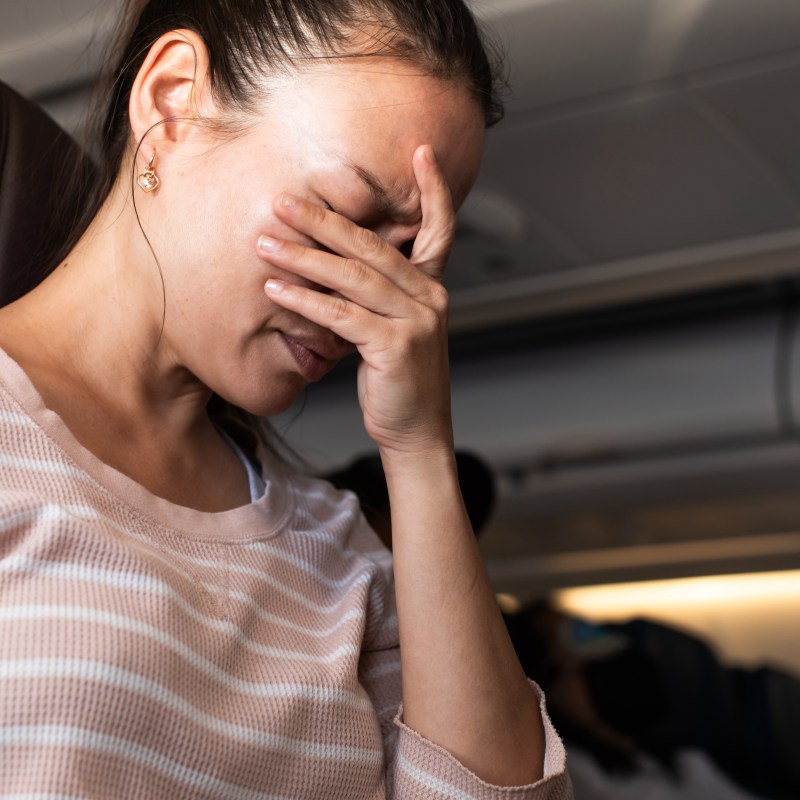
Some flights make me more nervous than others, and I’m pretty sure it’s all down to my stress levels.
Videos by TravelAwaits
When life is a breeze, I board planes without a second thought. When I’m exhausted and overworked, I tend to get spooked when turbulence hits. In fact, over the years, I’ve even begun avoiding window seats for aisle seats to help manage my anxiety. (The lack of space never helps.)
In a surprise twist, I found myself looking into how to manage sudden stress while soaring thousands of feet in the air… after well over a decade of taking regular long-haul flights.
To this day, I rely on breathing exercises and meditation to get me through tough flights. Again, I’ve noticed a correlation between my mental state and how nervous I get when flying. The less stressed out I am, the less likely I am to get anxious.
Along the journey to figure out how to calm myself at 40,000 feet, I’ve uncovered some scientifically backed tips to minimize anxiety, along with tips from other travelers. If you’re someone who has struggled with feeling nervous while boarding flights, you might want a refresher on how to avoid fear of flying in 2026.
These are some of my favorite tips, tricks, and factoids to get me through flights when I start to feel jittery.
10 ways to handle fear of flying: tips, tricks, and comforting things to know
#1: Avoid caffeine and alcohol
I recommend avoiding caffeine and alcohol on flights because they exacerbate issues like dehydration and even jet lag. That being said, I usually have a coffee on my flight or right before it, especially if I’m going to get some work done.
But even I skip out on coffee when I’m feeling stressed. Both caffeine and alcohol can create a heightened sense of anxiety. Caffeine will, literally, get your heart beating faster, which can make it difficult to stay calm.
Alcohol can do the same, and even contribute to nausea. If you’re prone to hangxiety, a term that describes heightened stress during hangovers, alcohol might make you even more nervous.
#2: Airports and emergency landing fields can be found even in the middle of the ocean
Tips and tricks will help you reduce your fear of flying—but I’ve also found that knowing a bit more about aviation and air travel has helped soothe my worries. Here’s one of my favorite facts: Pilots can access emergency landing fields even when flying across the ocean.
Sure, the Pacific Ocean has a few seriously remote routes—but those aren’t frequented by everyday travelers like you and me. In other words, if you tend to feel nervous flying over large bodies of water, you can rest easy knowing that airports and emergency landing strips can be found on dozens of highly remote islands.
#3: Connect to the world around you
Here’s a trick that will help if you’re starting to panic: connect with the world around you. Count five things that you can see. Count five more that you can smell—unfortunately, you’re on a plane, so don’t expect any flowery scents. Count five things you can hear, feel, and even taste, if possible.
This exercise helps ground you in your physical body, which can make it easier to avoid overthinking. This is another reason why avoiding caffeine and alcohol is a good idea—you’ll avoid stressing out your body in addition to your mind.
#4: The ‘drop’ is normal
I could be enjoying a normal, stress-free flight, but the second I feel a sudden drop, my ears perk up, so to speak. The sudden drops, which make you feel like you’re in a momentary free-fall, are actually due to thrust reduction or turbulence.
Thrust reduction occurs when a flight is done ascending. The nose of the plane drops to a more horizontal angle, which the body misconstrues as a drop. In the case of turbulence, it really is a drop due to a downdraft—but it’s usually no more dramatic than moving a few inches downward. In short, the plane isn’t actually free-falling.
#5: If you’re getting spooked, watch the flight attendants
As with tip #3, this is a handy trick if you feel panicky. Look at the flight attendants. Watch them handle their responsibilities for a few minutes. Do they look worried? Are they going about business as usual? I’ve found that watching flight attendants do their thing reminds me that they fly multiple times a day without any problems. If they aren’t panicking, why should I?
#6: Airplanes produce lift at speed, meaning you’ll glide down even if both engines are cut
Let’s dig into a little worst-case scenario. (Or keep reading if you don’t want to think about anything unpleasant.) Imagine both engines cut out mid-flight, leaving the airplane without power high in the sky.
If that scenario should play out, you’ll be comforted to know that planes don’t just fall to the ground. Their wings are designed like a bird’s wings, which glide through the air. Commercial flights would glide from around 90-100 miles at an altitude of around 35,000 feet before reaching the ground. That gives pilots plenty of time to find a safe place for landing. Plus, there’s a backup system called an RAT or Ram Air Turbine that powers critical flight controls.
If you remember the film Sully (2016), it covers a real-life pilot who safely landed a commercial flight on the Hudson River after geese downed both engines shortly after takeoff from LaGuardia Airport. He glided the plane safely onto the surface of a river, saving all 155 passengers.
#7: There’s a breathing exercise that will calm you down: 4-7-8
If you prefer more tactile solutions, I have another exercise that will help calm you down. It’s called the 4-7-8 breathing exercise, which comes from yoga (specifically, breathwork, which is called pranayama). Inhale for four seconds, hold for seven seconds, and exhale for eight seconds.
The practice has been linked to stress reduction and is used by some as a sleep hack. While scientific research backing the 4-7-8 breathing method hasn’t been released, it’s a handy tool to keep in your back pocket when you’re traveling. Even if you’re zenned out on flights, you might find the breathing exercise helpful for long waits, bumpy bus rides, or other hiccups.
#8: Picture turbulence moving through you
This is a short-and-sweet tip. If turbulence really spooks you, some flyers recommend not fighting it. Try not to tense up your body. Instead, picture turbulence moving through you. I’ve even seen someone recommend picturing the plane suspended in wiggling, encased Jello.
#9: Use your nose to calm down
I’ve also seen flyers recommend using essential oils to stay calm. If you find that calming scents have a soothing effect, you can do the same. This hack is a little tricky because you don’t want to disturb other passengers with a very strong scent. However, more neutral and pleasant scents like lavender or tea tree essential oil aren’t likely to bother anyone.
#10: Let the numbers paint a picture
If visualizations and essential oils don’t work for you, I have one last tip: Take a look at the numbers. Flying, after all, is safer than driving, something that Americans often do. The data paints a telling picture: Flying is safer than ever before.
Here’s the proof from MIT back in 2024:
- The risk of fatality from flights is one in every 13.7 million passengers
- Back in the 1906s and 70s, the risk of fatality was one in every 350,000 passengers, making flight today around 39x safer
- The chance of dying drops around 7% each year, based on findings between 1968 and 2022