
Plastic and heat don’t go well together.
Videos by TravelAwaits
Thanks to thermal expansion and something called polymer chains, heat causes plastic to soften and chemicals to degrade. When this happens, harmful chemicals like antimony, BPA, and BPS are released as nanoparticles and even microplastics.
The most common way that travelers deal with this type of chemical leaching is when we order food or prepare our own small dishes at our hotel or rental. For example, when I was studying in Taiwan, I ate a lot of 7-Eleven meals (it has a cult following in Taipei)—most of which were warmed up in plastic containers in my dorm microwave.
Those types of last-minute and late-night meals are inevitable.
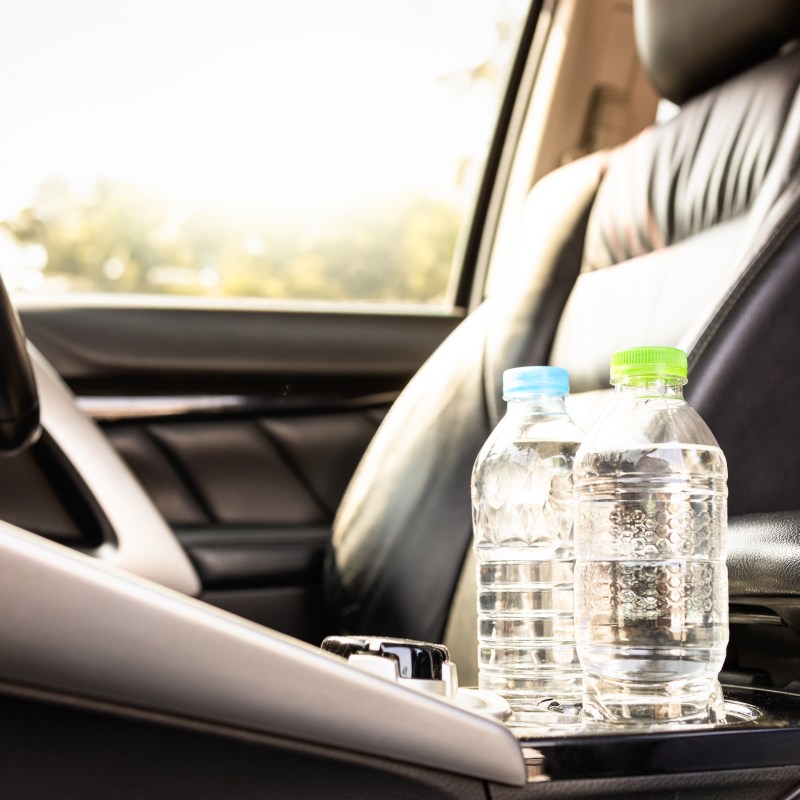
In reality, the bigger threat for American travelers when it comes to heat and plastic is the road trip. If you’ve ever brought a few bottles of water with you on a road trip during a heat wave, you might have exposed yourself to harmful substances. That’s troubling considering the vast majority of Americans like to wait until the weather clears up to hit the road.
If you’ve got road trips planned for this summer, it’s time to level up your water game. Here’s what you need to know about what happens when you leave a plastic water bottle in a hot car, and how drinking that water can affect your health.
What happens when you leave a plastic water bottle in a hot car?
I’m using a scientific study from Water Filter Guru to break down what happens to plastic water bottles that are left in hot cars. The company specializes in water filtration solutions, from well water to water softeners. If you’ve got questions about water treatment, filtration, and safety, they’re a solid resource.
Now onto the fun stuff.
The study from Water Filter Guru compared lab results from water from a plastic water bottle versus a stainless-steel water bottle, which were both left in hot cars for extended periods of time. The metric ‘ppb’ stands for ‘particle per billion’, which shows how much of a chemical is in the water supply. The higher the number, the more chemicals are in the water.
The test screens for 126 chemicals that can leach from plastic into water, including volatile organic compounds (VOC) and semi-volatile organic compounds (SVOC). Some of those are carcinogenic, while others have other long-term negative health effects.
Water from stainless steel water bottles didn’t show any VOCs or SVOCs when tested after three days in a hot car. However, water from plastic water bottles showed high levels of these chemicals:
- DEHP, 2.58 PPB: DEHP are phthalates, one of the biggest VOCs that is released when plastic thermal dysregulation happens. The EPA classifies DEHP as a probable carcinogen in humans.
- BDCM, 1.09 PPB: BDCM is a leftover from chlorination processes, which are used to filter water and aren’t caused by plastics leaching. Still, the CDC considers BDCM to be a probable human carcinogen, meaning you might consider minimizing the long-term usage of plastic water bottles.
- Chloroform, 17 PPB: That’s right—plastic water bottles left in hot cars can leach chloroform into the water supply. According to the study from Water Filter Guru, it’s possible some chloroform was present in the filtered water prior to the experiment because it’s used to help filter drinking water. However, very low levels were found in the stainless steel bottle compared to the plastic water bottle. The CDC also considered chloroform to be a probable human carcinogen.
- THMs, 18.09 PPB: THMs are trihalomethane compounds, which are most often present due to water sanitization. In short, you don’t need to worry about these levels—they’re normal.
How to safely store and bring water on your road trip
I’d hate to present a doom-and-gloom look at plastic water bottles. We all rely on them from time to time when we travel, even if we’re usually militant about avoiding single-use plastics. To be clear: the PPBs listed above are not dangerous for human consumption. The real risks come from long-term use.
Still, it’s a great reminder to avoid leaving plastic water bottles in the car during road trips in warmer months.
Here are three tips on how to safely store and bring water on your road trip:
- Keep a cooler in the car and store your plastic water bottle sin there if you’ll be leaving the car for a while. It’ll help offset heat exposure.
- If you’re too late and a bottle has been sitting in the heat, you can still use the bottle. Water Filter Guru recommends dumping the water in there, then refilling it and drinking it quickly. That way, you’ve dumped out the water where more chemicals leeched.
- Find a reusable water bottle. I’ve had many reusable water bottles over the years. My favorites are glass bottles—but they’re very heavy, which is a major travel drawback.
