
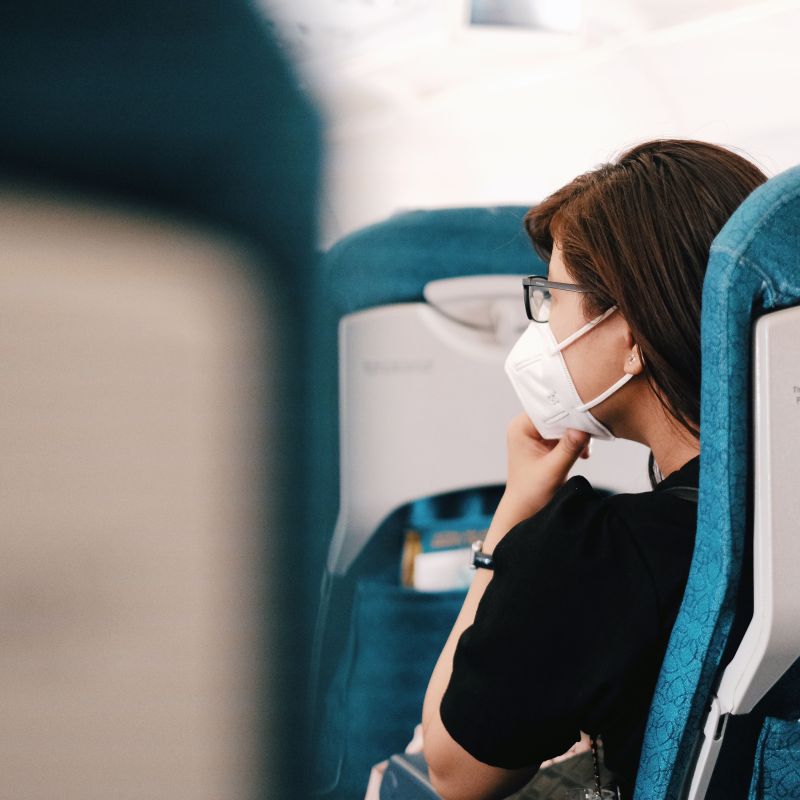
Imagine stepping onto a ten-hour long-haul flight, bag in hand and eyes locked on the overhead cabin.
Videos by TravelAwaits
You’re looking for your seat, and for an open space to store your suitcase or duffel. You’re double-checking that you have all your important items with you to store under the seat in front of you.
Then you hear a cough. Not a gentle cough or a low cough that usually comes with a common cold or allergies—instead, this is a deep-chest, wet cough. The type that comes with a more serious ailment, like, say, the flu.
It’s the type of cough that sends chills up a passenger’s spine, especially when the cougher in question isn’t wearing a mask. Unfortunately, it means one thing: You’re sitting close to a sick passenger, and you’ll be sharing recirculated air with them for the next ten hours.
It’s a tough spot to be in, but there are tips and tricks you can use to try to avoid the brunt of the illness. Here’s how to stay healthy on a plane when a visibly sick passenger is seated close to you.
How to stay healthy on long flights: the basics of preparing
Here’s the cold, hard truth: You need to prep for these types of scenarios, since your options once you’re on the plane are limited. As a travel writer who flies often, I keep a few supplies with me to help minimize the impact of germs and dry air on planes for long-haul flights. (The latter will dehydrate you, which can weaken the immune system.)
Here’s what I bring with me when I fly long-haul:
- A mask that covers my mouth and nose
- A large water bottle (purchased in the airport)
- Supplement packages that are high in Vitamin C, zinc, and magnesium
- Supplement packages with electrolytes for added hydration
- Sanitizing spray or wipes
- Neck scarf and fuzzy socks in case the cabin is cold
I also try to avoid sitting next to the bathrooms on long-haul flights. Foot traffic is high in that area, meaning you’ll be interacting with germs from more passengers as they use the restroom. Generally speaking, window seats with less air movement can protect you from the germ highway, aka the aisle.
How to stay healthy on a plane when someone visibly sick is sitting close by
The best way to stay healthy on a plane when a passenger close to you is obviously sick is to have a little health-focused arsenal in your bag with the items listed above. But hindsight is twenty-twenty, and we don’t always arrive fully prepared.
So, let’s say you show up to your flight without a mask, supplements, sanitizing materials, or even a neck scarf to keep you warm—what should you do?
First, ask the flight attendant for a mask. Flight attendants usually have surgical masks on hand in case passengers request them. Ask for one early—you won’t be the only one asking for a mask if a passenger is visibly sick and coughing. If you notice another passenger has extras, don’t be afraid to ask politely if they have enough to share.
Second, start slamming water like it’s your job. Cabin air is drier than a desert—your body will be fighting dehydration even if you don’t feel it just yet. Staying hydrated can boost your immune system, helping it fight off those Typhoid Mary germs by keeping your mucous membranes balanced and keeping your lymphatic flow moving.
Third, avoid the passenger in question like the plague. It’s important to have compassion for sick passengers—you never know what compelled them to board the flight despite their illness. But you don’t need to spend time around them. If you’re seated next to the passenger, ask for a seat change. Be direct about not wanting to get sick. When you get up to use the bathroom or stretch, head far from Typhoid Mary.
Fourth, sanitize your seat and make sure the air vent is pointing at your face. You can ask flight attendants for sanitizing wipes or sprays—they’ll share if they have any. After your seat and screen have been sanitized, make sure the air nozzle overhead is pointing at your face to keep air molecules moving.
Lastly, don’t touch your face. You might remember the COVID protocols that recommended not touching your eyes, nose, or mouth. You don’t want germs to touch your mucous membranes because they can absorb viral particles. In other words, you might not contract a virus by breathing but instead through touch transmission.