
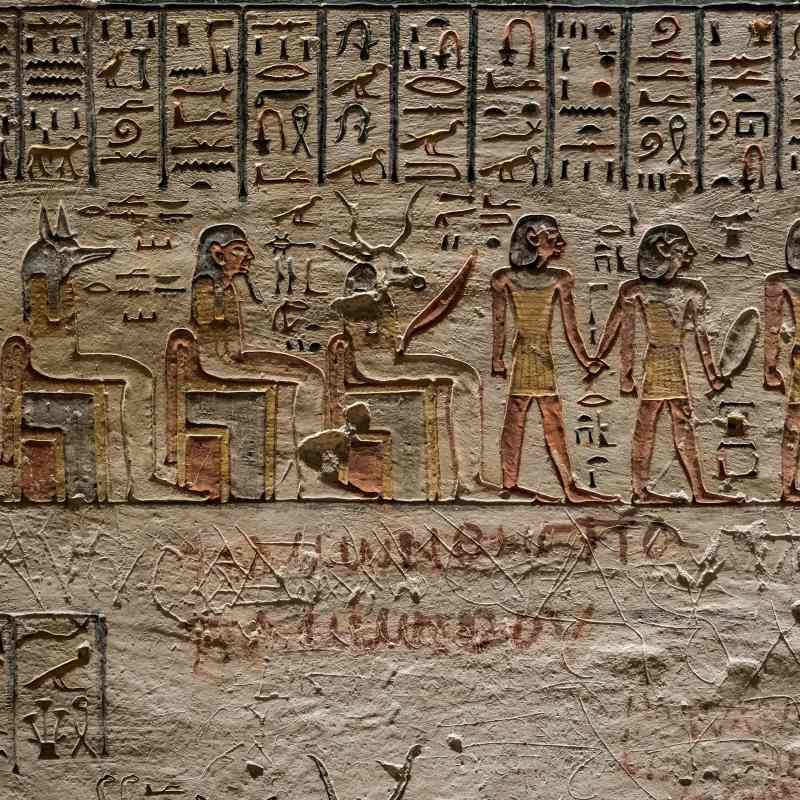
Tourists who leave their mark on major monuments and landmarks are viewed as criminal vandals—not street artists.
Videos by TravelAwaits
They’re an especially loathed type of traveler. After all, who would think to carve their name into the Colosseum? Or spray paint their name onto an ancient wall in Chiang Mai? Or deface some of North America’s oldest rock paintings?
The list of incidents of tourists committing vandalism is, unfortunately, long. On one hand, the actual vandalism is minimal—it’s mostly young people writing their names, as though it will immortalize them. On the other hand, these acts have longstanding effects on the monuments in question and the local view on tourism and tourists.
That being said, some examples of tourist vandalism are outright cool.
What makes them so appealing? They’re from the distant past, offering us one kernel of insight: Maybe humans haven’t changed that much. And maybe ‘tagging‘ is human nature.
Halfdan: Historic vandal from the 9th century in Constantinople
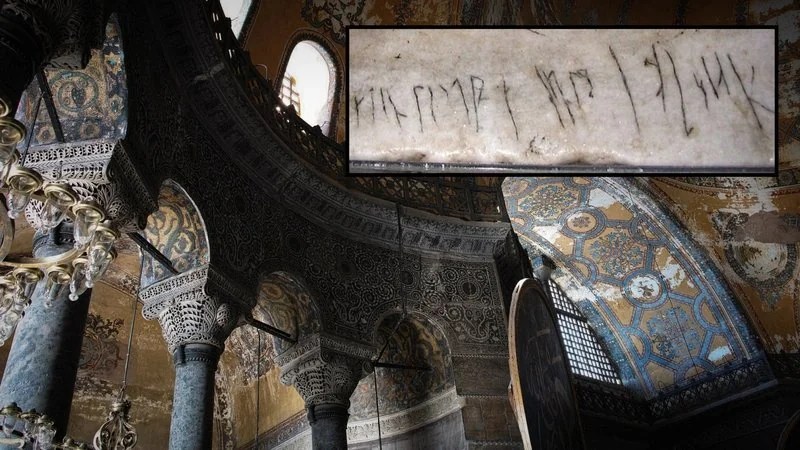
If you’re into both travel and history, like me, I highly recommend checking out the @ByJacklynn Instagram page. She’s a history buff who travels to ancient sites. She recently visited Turkey, where she made a stop at Hagia Sofia, aka the Blue Mosque, in Istanbul.
There, she observed a small, covered segment of original marble, which is pictured above. The encasement preserves a sentence that was carved into the mosque’s marble over one thousand years ago. It reads, ‘Halfdan carved these runes’. Halfdan is a Viking name.
So, how did a Viking end up in Istanbul (then Constantinople) sometime between the 9th and 11th centuries? And why did he feel the need to carve his name onto the marble? After all, that’s the same type of vandalism that’s committed by travelers today—they write, paint, and carve their names onto famous landmarks.
According to Jacklynn, this vandal was likely part of the Byzantine Emperor’s personal bodyguards, who were known as the Varangian Guard. The Varangian Guard were Norsemen and Anglo-Saxons who were feared for their skills as warriors and contracted to work for Byzantine nobles in the capital of Constantinople.
Cikai Korran: Historic vandal from the Valley of the Kings in Ancient Egypt
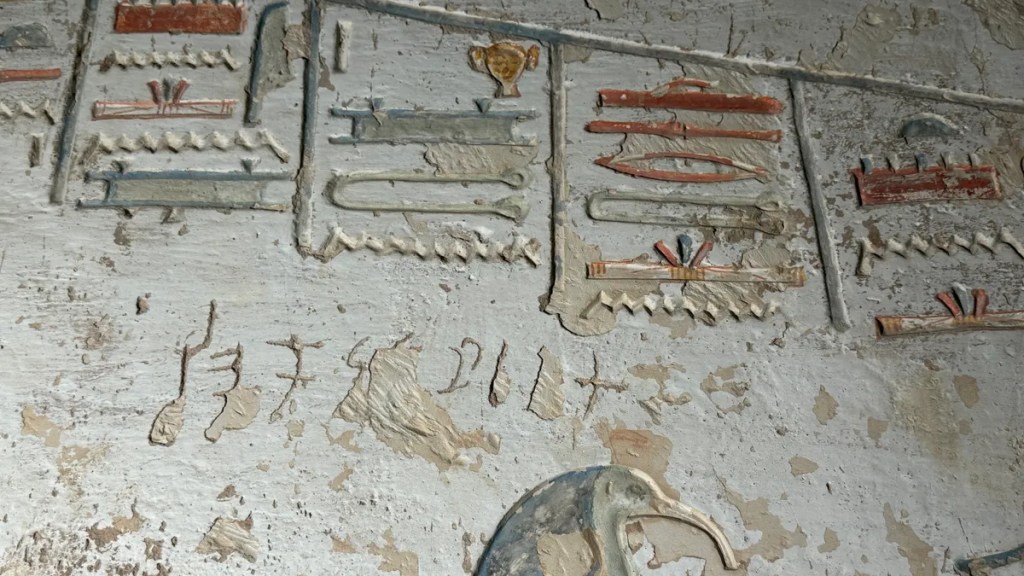
The Valley of the Kings, a popular site to explore Ancient Egyptian ruins in Southern Egypt, is home to the earliest-known incident of tourist vandalism. It’s thought to have been left by a spice trader who was visiting the area before heading back to India. (A business traveler, then.)
Any guesses as to what this vandal carved into the walls of one ruin… in at least eight different places across five different tombs?
His name. The inscriptions he left behind read, ‘Cikai Korran came here and saw’. We know it was written by an Indian man because the script is in Old Tamil, the predecessor to modern Tamil. Tamil is spoken in Tamil Nadu, the southernmost state in India—you might know the capital, Chennai.
Interestingly, some of Korran’s inscriptions were found as high as five to six meters (or 16-19 feet) above one tomb entrance. That being said, Korran isn’t the only traveler to have left his mark on Ancient Egyptian sites, although he’s the only name we have. If you want to learn more, check out this piece from Ancient Origins.
