
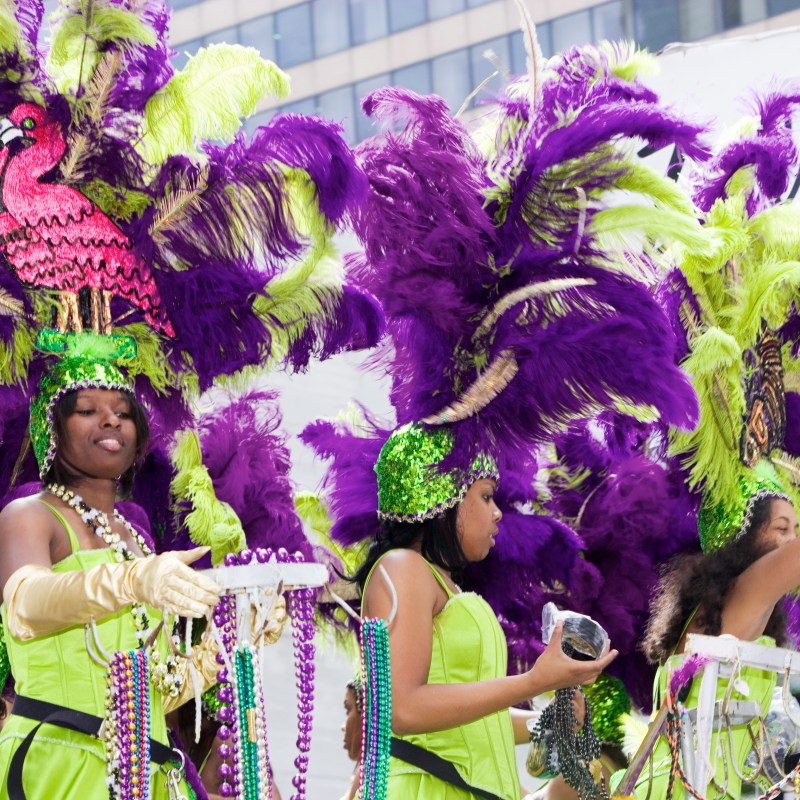
Even if you have the parade schedule for Mardi Gras in New Orleans, do you really know what’s going on? And even if you’re visiting with a local at your side, are you sure you won’t get turned around?
Videos by TravelAwaits
If you’re traveling to New Orleans over Mardi Gras, you’re in store for an unforgettable adventure. (Assuming you don’t drink too much and wipe your memory, that is.)
But you need to know a little bit about the routes and parades, along with the organizations that actually put them together. In short, there’s a lot of lingo and a lot of NOLA-specific factoids that first-timers probably won’t know… and possibly even those who have attended a Mardi Gras party in the city before.
Ready your masks and make sure you bring a pair of comfortable shoes—it’s time to dive into New Orleans Mardi Gras tips.
New Orleans Mardi Gras tips—for first timers and return visitors alike
Tip #1: Know the lingo
New Orleans’ relationship to Mardi Gras started in the early 1700s, when it was known as the Twelfth Night Ball. For centuries, Mardi Gras culture has slowly evolved into what we see today. Unsurprisingly, given NOLA’s history as a melting pot for colonial, African, and indigenous groups, there are a few pieces of lingo you might not have heard before.
Here’s the lingo you should know:
- Krewes: Social clubs that create floats and lead parades and balls. They work together year-round to create next year’s Mardi Gras gear. Usually, you’re born into a krew—like being a sports fan of a specific team, it’s generational.
- Super krewes: The city’s largest and most influential krewes. These are: Bacchus Krewe, Rex Krewe, Endymion Krewe, and Orpheus Krewe.
- Flambeaux: A member of a krewe who holds a flaming torch to lead the parade. This is a historical tradition carried on from 1857.
- Float riders: Members of krewes who ride the floats and throw items into the crowd.
- Throws: The items thrown from floats. These are a big deal (which we’ll get to below), and come in many shapes and sizes beyond traditional beads.
- Doubloons: Specialized throws that are coins and are customized for each krewe. Some people view these as collectibles—they’re perfect souvenirs for your Mardi Gras experience.
- Laisses les bon temps rouler: NOLA’s French motto that means ‘let the good times roll’.
- Mardi Gras: Mardi Gras is French for Fat Tuesday. If you see Samedi Gras, that’s French for Fat Saturday, another popular day for parades.
- King cake: a circular cake with a hidden baby inside—whoever gets the baby gets a year of good luck.
Tip #2: Learn about the parades & krewes
Aside from the lingo, you also need to know about the main parades. Parades are organized by krewes—meaning every Super krewe has its own parade. The more influential the krewe, the closer to Mardi Gras that the parade is held. Remember: Mardi Gras festivities occur in the weeklong lead up to Fat Tuesday.
Krewes create new creative themes that define the parade and the floats that you see. Most incorporate deep-seated elements of NOLA identity, but also touch on pop culture, history, recent events, and more. The ‘throws’ reflect the theme.
In short, research krewes to figure out which parades you want to attend. Here’s a quick rundown of the main major krewes and their parades:
- Krewe of Muses – all-female krewe with signature shoe-shaped throws. Their parade is usually on Thursday.
- Krewe of Hermes – A krewe started in the 1930s that has the winged god Hermes at the head of the procession. Their parade is usually on Friday.
- Krewe d’Etat – A modern krewe started in the 90s with a secretive leader who acts like a despot monarch. Their parade is usually on Friday, just like Krewe of Hermes.
- Krewe of Endymion – The largest parade of the bunch and known for its extravagant, colorful, and over-the-top floats. This is one of the most historic krewes. Their parade is held on Saturday, Samedi Gras.
- Krewe of Bacchus: Known for having celebrity monarchs (who lead the parade) and popular signature beads. Their parade is usually on Sunday.
- Krewe of Orpheus: Also from the 90s, this new krewe is all about celebrity guests (from Ann Rice to Whoopi Goldberg) and great music.
- Krewe of Zulu: One of the oldest and most original krewes in the city, this majority-black krewe is a piece of the city’s living history and culture. They rule on Mardi Gras.
- Krewe of Rex: Home to the symbolic King of Carnival (Rex = king in Latin), this storied krewe dates back to 1872. It also holds its parade on Mardi Gras.
Tip #3: You can use a parade tracker app
There’s a parade tracker app, in case you get turned around during the fun. The krewes listed above hold the largest parades in the city, but they’re far from the only ones. You can find smaller parades from neighborhood krewes around the city. Just make sure to double-check before you attend the parade if you have kids with you.
Some are designed to be family-friendly, while others are very much in adults-only territory. There are even pet-based krewes, including the Mystic Krewe of Barkus, which takes over the French Quarter for a short parade each year.
Download the WDSU Parade Tracker to figure out what’s going on where, and what the crowds are like, and even what the weather is like.
Tip #4: No grabbing items from riders or throwers
Here’s your top Mardi Gras tip: Make sure you pick up those signature throws—but don’t grab them from hands or throwers. Instead, you need to stay behind the partition and hope that you get lucky enough to catch the throws you’re interested in. Usually, there’s plenty to go around.
Tip #5: Wear gold, green, or purple
Gold, green, and purple are the colors of Mardi Gras. (These are based on the Three Kings from Catholic storytelling, if you’re interested.) The best way to dress up for Mardi Gras is to be comfortable and wear accents with these colors. If you want to dress over the top, you’re more than welcome—you won’t stick out, I promise.
But if you just want to stay warm and comfortable, a festive hat or sunglasses in gold, green, or purple will get the job done. And I highly recommend prioritizing comfort: rideshares are almost impossible to catch during Mardi Gras’s peak times, meaning you’ll be walking a lot.
