
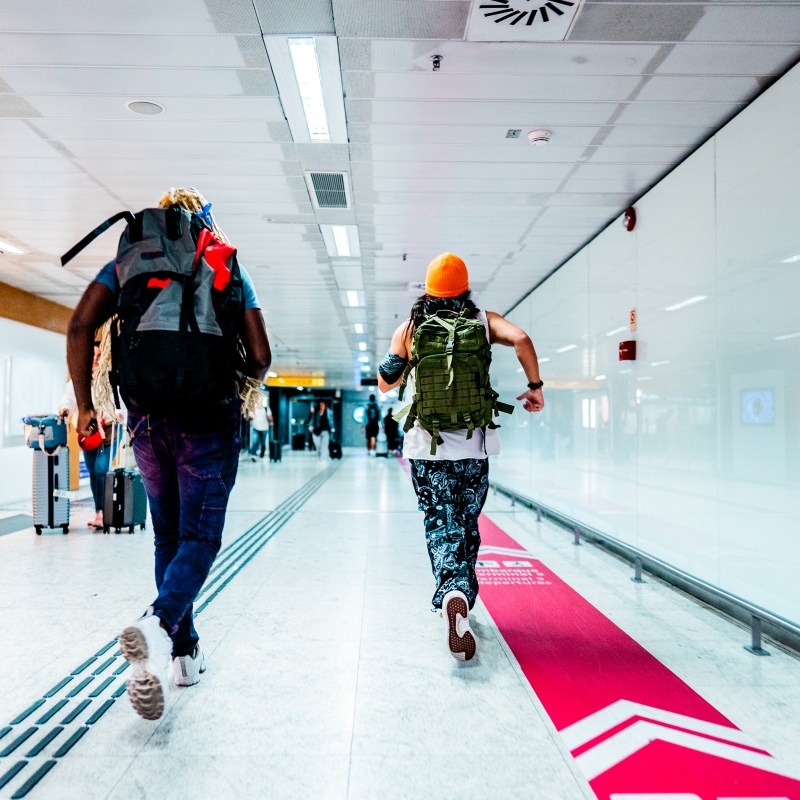
Delays at the airport are part of air travel, plain and simple.
Videos by TravelAwaits
Factors like weather, technical issues on planes, and staff strikes regularly impact delays. Other larger circumstances, such as the ongoing government shutdown, can also wreak havoc on things like security lines and air traffic control schedules.
On top of these elements, there’s another very important factor at play: how well-organized and modernized is the airport?
For example, US airports like Atlanta-Hartfield International Airport and Chicago O’Hare International Airport are some of the most high-traffic in the US—and also the most well-oiled. Thanks to careful planning, ongoing improvements, and unique programs like live musical concerts and large-scale art exhibits, passengers can get to their gate on time and, in some cases, with a bit of razzle-dazzle.
Other airports… not so much.
If you’re wondering which major US airports are hard to navigate, start with this list. Give yourself plenty of time to check in and get through security or time to transfer, if you have a connecting flight.
Airports that are hard to navigate—give yourself extra time to get around!
San Francisco International Airport (SFO)
With three terminals for domestic flights and one international terminal, you might need to run if you’re hoping to make your connecting flight across the US. Passengers have reported that SFO’s signs are easy to read, making navigation fairly easy. The issue here is distance. It might take up to 15-20 minutes to clear a single terminal.
Fort Lauderdale – Hollywood International Airport (FLL)
FLL is a relatively small airport, making it fairly easy to navigate. The issue is that the terminals aren’t connected via train, meaning you need to leave one terminal, take a shuttle, and then go back through security to enter another terminal. The plus side is that the weather will likely be perfect for a little outdoor connection.
Dallas-Fort Worth International Airport (DFW)
I have good news and bad news about DFW. The good news: it has a chic Skylink train that will zip you around from terminal to terminal without requiring you to go back through security. The bad news: the distance between DFW’s two furthest gates is a whopping 2.16 miles, according to a study by Reader’s Digest. DFW is the second-largest airport in terms of sheer square miles in the US, at almost 27 square miles.
Washington Dulles International Airport (IAD)
Washington, DC’s IAD is another mind-bendingly large airport. Passengers could walk up to 1.62 miles from end to end if they’re unlucky with their gates. Worse, it’s also the US airport that’s most prone to delays in 2025. Thankfully, IAD has a solid underground tram system, meaning you won’t be expected to trek that full length.
Orlando International Airport (MCO)
Spanning around 23 square miles, Orlando’s MCO is a large airport that takes time to navigate. On top of that, many passengers are first-time or infrequent flyers, making security lines longer. The upside is that MCO has a transportation system and a simple dual-terminal-in-one layout. The downside is that if you get on the wrong transport, you might accidentally leave the airport and need to go back through security.
Miami International Airport (MIA)
From just about every angle, Miami Airport is hard to navigate. Signage isn’t the best, terminals are rundown, and the layout is in a U shape. The concourses are also listed by letter instead of number, which isn’t very intuitive. Worse, many areas are narrow, meaning passengers rushing between gates are bottlenecked. Did I mention it’s also one of the US’s busiest airports for connecting flights?
Philadelphia International Airport (PHL)
Similar to MIA, PHL lists its terminals with letters instead of numbers. There’s also a dual terminal: A-East and A-West. While all terminals are located past security (meaning you never need to re-enter), they’re connected by shuttle buses, which are more prone to delay than trains. Thankfully, the airport offers an interactive map that makes figuring out where to go easier.
Los Angeles International Airport (LAX)
LAX also uses a U shape, which can be confusing, especially for passengers who are deboarding an international flight and have a domestic connection. Some terminals are connected by air train, while others aren’t. Though the airport recently unveiled a new public transport system, it’s also renowned for its nightmarish curbside pickup system for anyone needing a taxi or rideshare.
John F. Kennedy Airport (JFK)
JFK is a massive, complex operation that could see you trek up to 1.38 miles. While it has an air train system, it’s not the best organized. On top of that, some areas aren’t large enough for the sheer number of passengers that pass through JFK, including security lines. On top of that, its security and customs staff are known for being loud and impatient.
