

As someone who lives in a small one-bedroom apartment in the middle of a busy city, I often seek out wide open spaces when I travel.
Videos by TravelAwaits
I enjoy the chance to stretch out in a large, airy hotel room or rental. I seek out nature, too, from parks to overlooks to beaches. I savor the opportunity to escape crowds, whether I’m heading into the countryside or out on a day trip.
But there’s a steady rise in the number of micro hotels and tiny homes for travelers to rent. Earlier this year, I covered Marriott’s Postcard Cabins, a new project that combines glamping with tiny home-style cabins. The goal is to let travelers drop off the map in nature with minimal digital distractions.
But if you’re new to tiny homes, you might find the setup a little challenging. If you’ve never encountered modular furniture or learned how to pack in a minimalist style, staying in tiny home rentals or booking micro hotels might feel out of your wheelhouse.
They aren’t—you just need to know what to expect if you book a tiny home or a micro hotel room. Here’s the low-down.
What are tiny homes? And what about micro hotels?
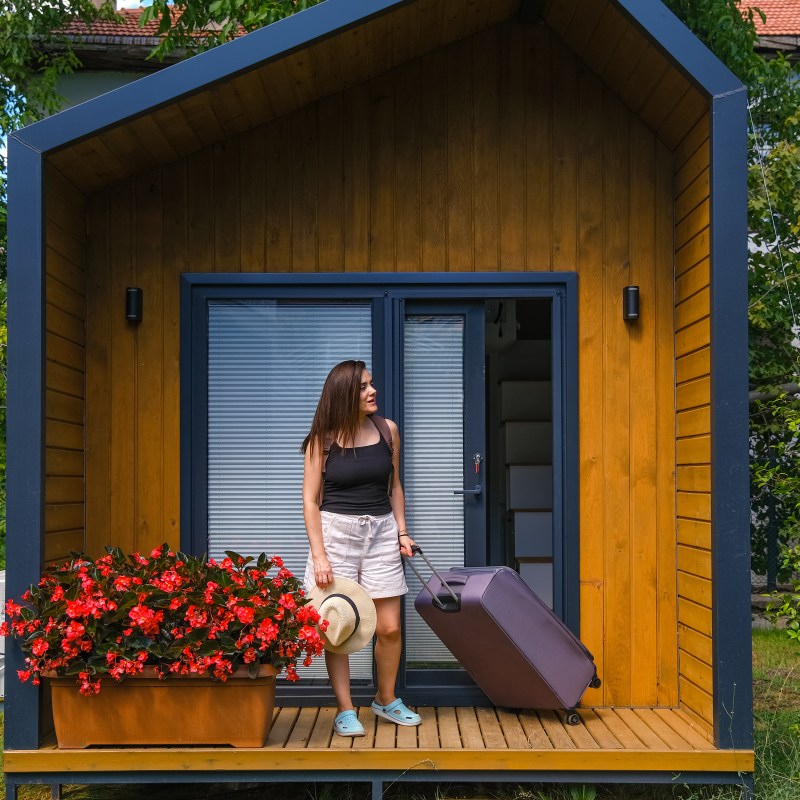
Tiny homes and micro hotels are miniature versions of standard rentals and hotel rooms. Tiny homes usually average a size of 225 square feet, but you could find them as tiny as 100 square feet or as large as 400. Micro hotel rooms also fall within that range, though they’re usually more like 350 square feet.
The idea behind both is to save space.
Micro hotels are usually located in big cities with dense urban populations—you’ll find them in spades in cities like Tokyo and Shanghai. They’re not quite as popular in the West, but you can absolutely find them in hubs like London, New York, Amsterdam, and Seattle.
You might already know of a few micro hotel brands in the US. Moxy, Pod Hotels, and YOTEL all have micro hotel rooms that you can rent. They’re usually discounted thanks to their compact size, although they include all those amenities you’d expect—from high-speed wi-fi to designer toiletries.
Tiny homes, on the other hand, are more commonly found in the US than micro hotels, including in remote places. That’s thanks to the popularity of Airbnb and VRBO private rentals. Tiny homes are easy to construct and, in the case of Marriott’s Postcard Cabins, can also be placed in remote areas. That’s an important distinction here, as some tiny homes are also off-grid.
Micro hotels vs tiny homes: the drawbacks
The most obvious drawback of staying inside a tiny home or micro hotel is the limited space. You need to be adept at living in a minimalist style, meaning you’ll need to be mindful of where you put things—and you shouldn’t be dragging in large suitcases if you want to stay comfortable.
There are fewer drawbacks for micro hotels, in my opinion.
They’re usually located in city centers, meaning you can easily leave for meals or, if you’re feeling couped up, go on a walk. Plus, you have the benefit of hotel amenities outside your room, from ice machines to co-working areas. Aside from a small space, the main drawback is that you might need to share a bathroom. Not all micro hotels have compact ensuite bathrooms.
Tiny homes usually have fewer amenities, which depend on how remote they are and whether they’re geared toward digital detoxes. If you want fast wi-fi and unlimited hot water, I’d reach out to ask the host what to expect.
Because tiny homes are often standalone and remotely located, creature comforts might be more limited.
That being said, you can find urban tiny homes that are located centrally, come with all the amenities you want, and even include things that micro hotel rooms don’t—like a functional kitchen and ensuite bathroom. In short, tiny homes can be a lot more specialized, so you should always read the fine print.
Micro hotels vs tiny homes: the perks
Micro hotels are ideal for savings and convenience. Most rates are budget-friendly, and many micro hotels have workspaces and lounges where you can hang out and eat. Some might also let you check yourself in and out for added convenience.
Micro hotels are great for solo travelers and business travelers, especially those who want to stay in a central location.
Tiny homes run a larger gamut, as I’ve already outlined. You can find a tiny home for just about any interest, whether you want to escape the big cities in a Postcard Cabin or live off the grid at a mini Earthship even further out. Thanks to the home’s tiny size, you’ll be encouraged to get out into nature.
But don’t write off tiny homes in cities. Like micro hotels, they’re great for saving big, especially if you’re a solo traveler or are just in town on business. Just make sure you look closely at what is and isn’t offered in a tiny home, like wi-fi speed, kitchen appliances, and bathroom specs.