
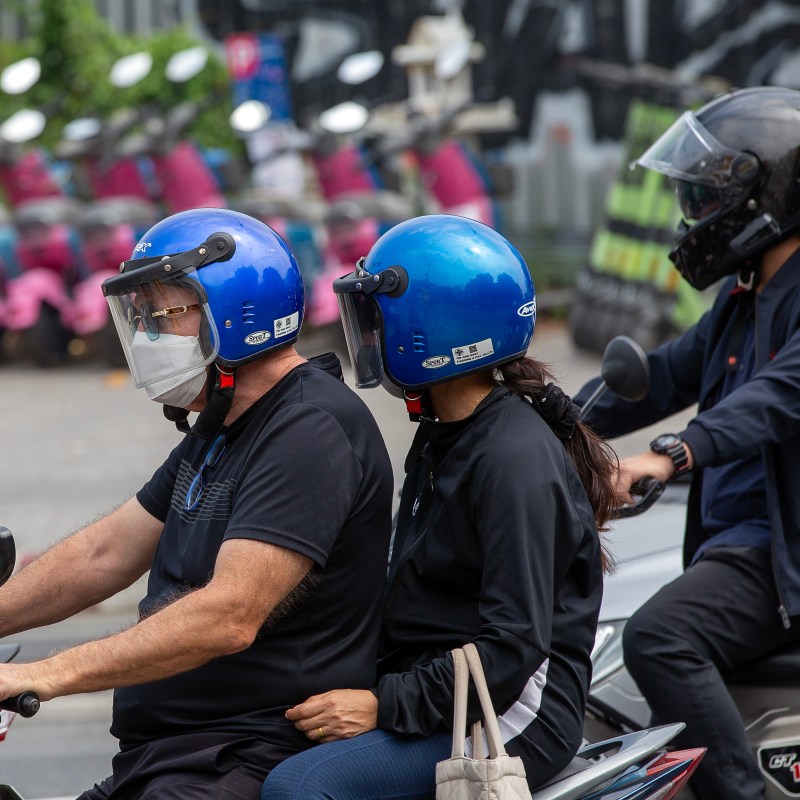
Tourists in Thailand often rent motorbikes to get around. Many also leave the country with something called a ‘Thailand Tattoo’—and, no, that isn’t a reference to the country’s sak yant traditions or that Mike Tyson face tattoo from The Hangover 2.
Videos by TravelAwaits
A Thailand tattoo is a colloquial term for a burn, scrape, or scar from a scooter—whether a full-on crash or just a little exhaust pipe singe.
While scooters are the de facto way to get around for those who don’t want to be bogged down in a tuk-tuk, they’re dangerous. Road rules are lax in Thailand, and tourists who lack experience navigating on packed streets tend to crash. Even sober drivers might get into trouble—after all, defensive driving can only get you so far in a scooter.
In short, reckless driving on scooters has become so commonplace amongst tourists in Thailand that it has a name. The Thailand tattoo. But it’s also become such an issue that officials working in medicine and hospitality have formed a coalition.
Their goal? Require tourists to buck up for medical insurance so that Thai hospitals aren’t bogged down with unpaid medical bills from scooter crashes.
Could Thailand institute mandatory accident insurance for tourists?
According to the Ministry of Public Health, foreign patients who end up in the hospital cost the Thai public health sector around 100 million baht every year, around $3.1 million. Most incidents are in popular tourist areas, like Phuket and Chiang Mai.
According to Dr. Weerasak Lorthongkham of Vachira Phuket Hospital, via the Bangkok Post, the hospital took a 10 million baht (just over $300,000) hit in terms of unpaid treatments. Some scooter accidents also aren’t as simple as patching up a rash or fitting an arm cast.
Dr. Lorthongkham recalled an incident in which a tourist was paralyzed from the neck down, but couldn’t get in contact with family to help pay for medical procedures. Not even the tourist’s local embassy was willing to cover the treatment, which required long-term care.
However, local authorities in Thailand are unwilling to turn away patients in need. First, because it violates the oath that doctors take to provide immediate care to those who show up injured. Second, it would damage Thailand’s global image.
For now, agencies in Thailand are setting up a plan to collect data related to tourist injuries on scooters and analyze how much it’s costing the country’s public health services. One expert travel agent has proposed that a modest fee of 300 baht per tourist could help offset costs, while others propose that insurance costs be integrated into entry visas and authorizations.
