
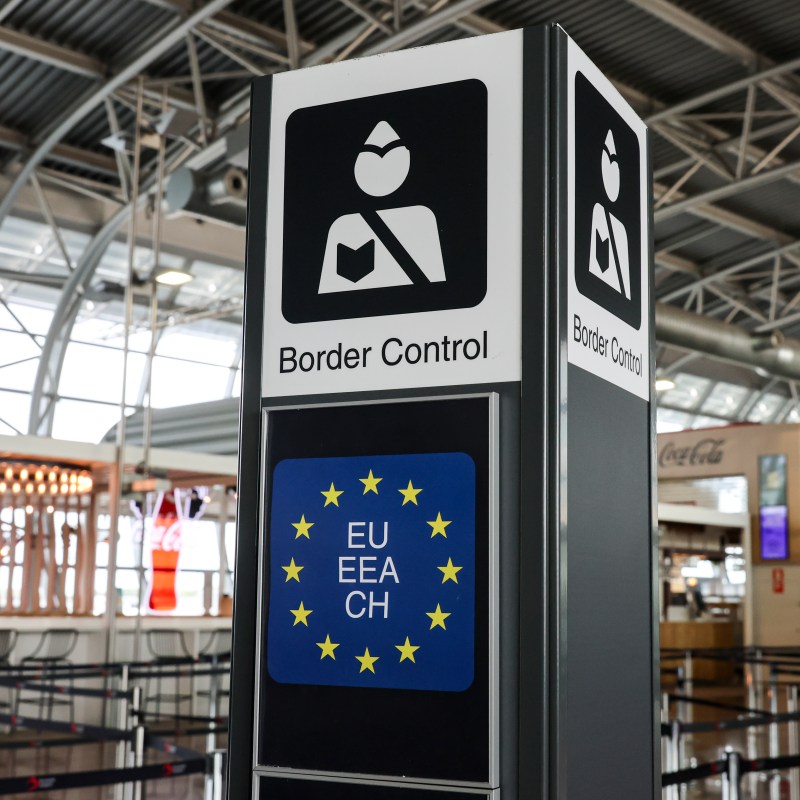
Starting tomorrow, the European Union and all Schengen Area countries will switch over to the new Entry-Exit System, aka EES.
Videos by TravelAwaits
The EES was first implemented in October of 2025. Since then, it has slowly expanded across the Schengen Area.
EES is a fully digitized system that the EU and the Schengen Area will use to document and manage border crossings instead of manual checks. The goal is to streamline documentation for residents and visitors throughout the Schengen Zone in a single, digitized structure.
Here’s a quick recap on the European Union versus the Schengen Area. The European Union is a group of 27 countries that work together to streamline economic and political systems, amongst many other topics. The Schengen Area is instead a group of 29 countries that have a shared approach to border crossing to simplify
The EES applies to Schengen countries in addition to European Union countries, meaning you need to go through EES border control to visit non-EU countries like Iceland, Switzerland, and Norway. Remember: Americans can stay inside the Schengen Area for 180 days per year, which is counted on a rolling basis.
In summary, the EES isn’t a Europe-wide system. It applies only to countries that are part of the Schengen Area agreement, which includes all 25 countries in the EU.
What to expect with the new EES system
Starting tomorrow, April 10 2026, the EES will be fully implemented across all participating countries in Europe. Because it’s a fully digitized system, you don’t need to present your passport to a customs agent. Instead, you’ll scan your passport, then head on to baggage claim.
But there are a few catches.
The EES works by capturing biometric details like fingerprints and facial scans. It also collects data like your name, passport data, and date and place of entry or exit. In short, you won’t get away with overstaying your Schengen allotment of 180 days by hoping the customs agent doesn’t notice—so don’t try it anymore.
Additionally, the EES is being implemented with the hopes of launching the ETIAS or the European Travel Information and Authorization System. That’s the travel authorization that Americans will need to fill out and pay for prior to visiting Schengen countries.
It’s been stalled because the EES must be fully functional before an ETIAS requirement can be implemented—but it could be required as soon as the end of this year.
Lastly, expect delays. Because EES is fully digitized, there have been hiccups throughout European airports. In fact, I experienced one last year when I flew from Europe to Montreal. I was connecting through Amsterdam, where I needed to exit the EU via an EES gate.
Because I’m a permanent resident of Spain who still uses a US passport, I was flagged. An agent came to get me because, based on the digital scan of my passport, I had overstayed my time in Schengen by… years. I already had my Spanish residency card in hand. I explained my situation. Agents took a look at the residency card, then sent me on my way. The interaction didn’t take more than two minutes.
I imagine cases like mine will cause ongoing delays with EES gates, at least for a few months. I recommend giving yourself extra time to go through customs when you enter and leave Schengen due to the new EES system.
